“It was very clear that the system was set up to make things difficult for me.”
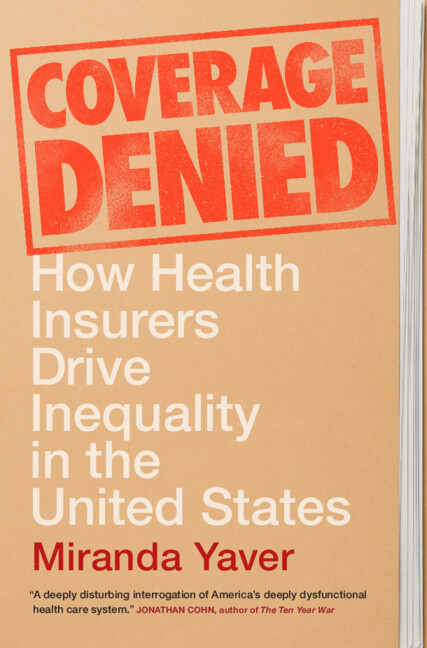
Those are the words of a D.C. woman who found herself struggling to get a birth-control prescription for dysmenorrhea — the simplest, most basic kind of claim — authorized by her insurer (UnitedHealthcare, if you’re wondering). She’s one of hundreds of people interviewed by Miranda Yaver, a health policy scholar at the U. of Pittsburgh, for Coverage Denied: How Health Insurers Drive Inequality in the United States (Cambridge U. Press, 2026).
The number of health claim denials has exploded over the last decade — and, as Yaver’s subtitle suggests, the effects of those denials are unevenly felt. The D.C. woman struggling with the birth-control denial happened to be relatively affluent, with multiple postgraduate degrees. After six weeks of phone calls and paperwork, she was able to wring some justice out of her insurer. But Yaver’s research shows that people with lower incomes and less education are less likely to appeal their denials, and less likely to be aware of the fact that appeals often succeed. Among people who’ve had a claim denied, people with relatively low incomes and relatively unstable employment are more likely to report that they’ve postponed medical care because of that denial.
Over the last fifteen years, the U.S. has done a decent job of reducing the number of people who are completely uninsured. But before we get too excited about that: As Yaver demonstrates, U.S. health insurance remains an engine of inequality even for people who are inside its tent.
Yaver places her argument in the tradition of scholarship on “administrative burden” — the paperwork and other bureaucratic hassles that (often by tacit design) prevent people from getting care they’re legally entitled to. Most of the literature on administrative burden focuses on applicants’ struggles to get enrolled or maintain enrollment in public programs such as Medicaid or TANF. Yaver’s book focuses on a different strain of administrative burden: the struggles of people who are fully enrolled in health insurance — often paying hundreds of dollars a month in premiums for the privilege — to receive the benefits to which they’re ostensibly entitled.
Those struggles are getting worse. The fragmentation of U.S. health insurance makes it hard to report clean numbers, but the pattern is clear. Whether we look at employer-provided insurance, ACA plans, privately-administered Medicaid plans, or Medicare Advantage, patients are finding their claims denied at enormous rates. One widely cited study by KFF found that in 2023, twenty percent of claims filed by patients on ACA marketplace plans were denied. When patients appealed those denials (and only a tiny fraction of them did file appeals), they prevailed 44 percent of the time.
That 44-percent reversal rate strongly suggests that, to a large extent, insurers are flinging denials at the wall to see what sticks. Is your contraceptive medication not quite the one that’s on our formulary? Denied. Did you submit your psychotherapy claim to your primary plan instead of to its behavioral-health subcontractor? Denied. Do you need home physical therapy, but we’ve decided to doubt that your legs are really that weak even though we’ve never met you? Denied.
Why do insurers act this way? From the insurers’ point of view, denying millions of claims is a politically costly strategy for defending their profit margins — but, as Yaver points out, it’s probably less politically costly for them than the alternative strategies of raising premiums or reducing their reimbursement rates. Raising premiums is a highly visible act that risks pissing off employers and legislators. Reducing reimbursement rates risks encouraging hospitals to drop their contracts with you. Denying claims, by contrast, is a diffuse process that patients and hospitals might gradually come to accept as business as usual. Sure, a small handful of patients will appeal their denials, and 30 to 50 percent of them will win reversals. But from the insurers’ perspective, that’s a small price to pay.
It goes without saying that claim denials can have dire consequences. Yaver relates the story of Kathleen Valentini, a North Carolina woman who sought care for a new onset of hip pain. After physical therapy gave no relief, her orthopedist ordered an MRI, which her insurer denied on grounds of medical necessity. After an appeal that took more than a month, Valentini was permitted to get her MRI, which identified a sarcoma that required amputation of her leg. Her disease was later found to have spread to her lungs, and she died two years later. Had her sarcoma been found in a timely fashion, her oncologists believed, she might have avoided surgery and metastasis.
Alongside those sometimes-severe clinical consequences, the claim-denial machine gives rise to a more mundane bureaucratic misery. Patients are ambushed by insurers’ formulary changes on January 1, suddenly told that medications that have worked well for them for years are off the list. When insurers insist on “peer-to-peer” reviews of insurance claims, the reviewer on the insurer’s end often isn’t a true peer at all, but a physician from outside the relevant specialty. Some insurers carve out segments of their coverage — typically mental and behavioral health services — to outside subcontractors. If you’re not aware of that external entity and you submit your claim to the wrong office, you’re out of luck. And on and on.
To her credit, Yaver doesn’t pretend that all claim denials are per se illegitimate. She acknowledges that the U.S. health care is plagued by overtreatment and low-value care. Most physicians and other providers want what’s best for their patients, but a few are out to work the system for as much money as they can. Someone, somewhere, somehow has got to keep an eye on things and hold physicians accountable. But are private insurance companies and their claim denials the optimal way to achieve that accountability? Clearly no.
One potential mechanism that Yaver sketches would be a system of retrospective audits, with an eye toward identifying physicians whose practices are far outside the norm:
Auditing prescribing outliers and issuing random audits of others would make physicians aware that their clinical judgment may be reviewed for medical necessity through a larger-scale retrospective review, with prior authorization operating as a penalty for overprescribers rather than the default for all.
In the meantime, we’re stuck with the status quo of private insurers (and means-tested public programs that carry their own kinds of misery). Do their denials even save the system money? In some cases, clearly no. Delaying care by days or weeks while you wrestle with an insurance company over an authorization often means that you need more (and more expensive) care than you would have if you’d gotten treatment at square one. According to one study cited by Yaver, hospitalization for gallbladder removal costs 22 percent more, on average, if it’s delayed by just a single day. Similarly, patients with lung disease are more likely to require expensive inpatient admissions if their insurers deny them access to high-quality medications. Medicaid enrollees with severe mental illnesses are more likely to require hospitalization if they’re in plans with relatively restrictive drug formularies.
From the insurers’ point of view, some of these apparently penny-wise-pound-foolish decisions might not be as perverse as they seem at first glance. A given insurer won’t necessarily be on the hook for the downstream consequences of the denials it issues today. People change insurance coverage all the time. They change insurers as they take new jobs, as they move from state to state, and as their level of economic precarity rises and falls. All of that churn means that insurers don’t necessarily have incentives to pay for an expensive therapy now to prevent an even more expensive hospitalization down the road. Their interests in the costs of your care are, for the most part, strictly short-term.
How can insurance companies and their denials be brought to heel? The best path (for this and many other reasons) would be a universal single-payer system that would render private insurance irrelevant. But while we’re struggling to win that, there are smaller reforms worth fighting for.
First, Yaver suggests that we should strive to establish a uniform legal definition of “medical necessity.” That might sound like a dull semantic game, but it’s not. Medical necessity is a crucial term of art in insurance contracts — but in most states, insurers aren’t required to publicly disclose the clinical standards that they use when they evaluate claims. They have their own secret sauce, which may or may not align with the recommendations of professional medical societies. As a model for this kind of reform, Yaver points to a 2020 California law that requires insurers to use non-profit clinical associations’ medical-necessity standards for mental health and substance use disorders. In theory, that approach could be applied to the full spectrum of medical conditions.
Second, we should rein in the process of prior authorization. This strain of reform is already well underway. In the last five years, the American Medical Association and its allies have successfully pushed for state-level laws that require insurers to complete their reviews within a reasonable time frame and to use reviewers with expertise in the relevant medical specialty. (The climate has shifted enough that UnitedHealth has announced it will eliminate roughly a third of its prior authorization requirements.)
Finally, we should work to establish more robust state-level support for patients who need help in appealing denials. Yaver points to Connecticut’s well-staffed Office of the Healthcare Advocate, which assisted more than 5600 patients in 2025. Connecticut and Maryland have recently enacted rules that require insurers’ denial notices to include large-font, hard-to-miss language up top about how to appeal the denial and how to seek help from the state.
The hope is that those prominent notices will broaden the range of people who know their rights and act on them. Only a tiny handful of people appeal their denials, and that’s understandable — nothing about the process is designed to be easy. But it’s a huge injustice. Yaver quotes at length a California activist with multiple sclerosis who has spent nearly two decades advocating for the care she needs:
They want you to think we’re stuck with these bills. They want you to think there’s nothing you can do. They do it just because they know that most people don’t understand the appeals process, and they hope that people who have to appeal are elderly or disabled and don’t know their rights. [. . .] Nine times out of ten, I win my appeals, but just having to do it is so hard. I can’t believe that this is health care.
We all deserve better.